

Qwen3.8-Omni-Flash Turns Audio and Video Into Agent Work, Not Just Model Input
Qwen3.8-Omni-Flash combines 1M-token text, image, audio, and video understanding with reasoning and tool use, targeting long-form multimodal agent workflows.
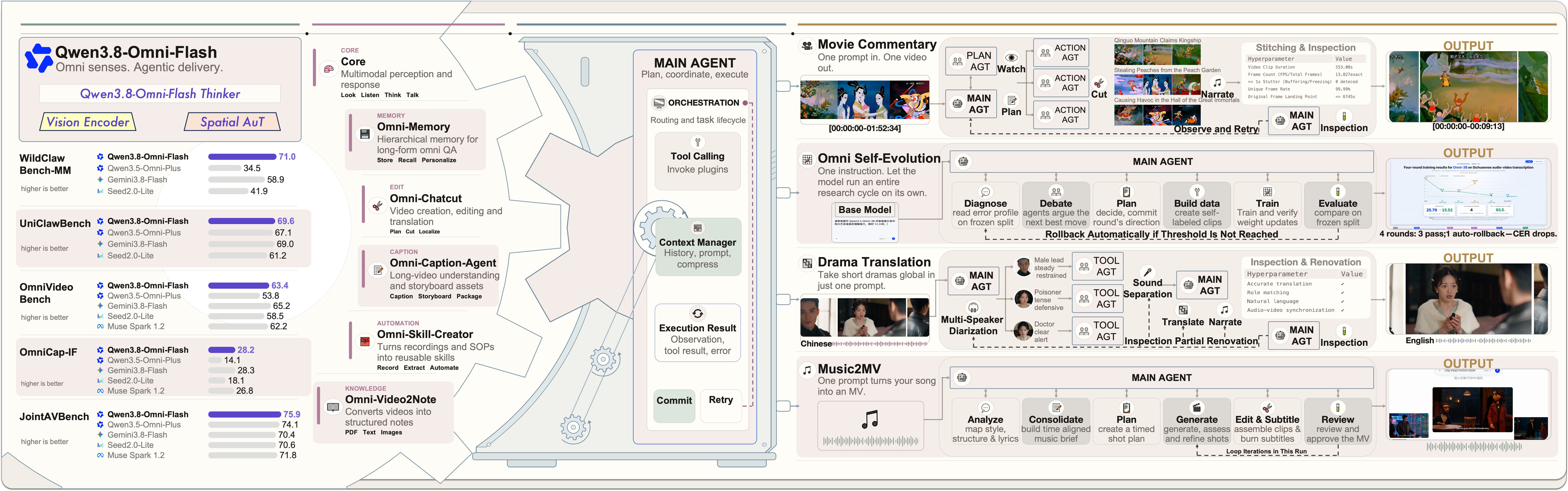
Multimodal models have been able to watch video and listen to audio for some time. The more consequential question is what happens after they understand it.
Qwen3.8-Omni-Flash, released on September 18, 2026, is Qwen’s attempt to move that boundary. It accepts text, images, audio, and video inside a single context, but the product is positioned less as a media-description endpoint and more as a sensory layer for agents: understand a recording, reason about the task, call tools, and turn the result into work.
That distinction matters. A model that can summarize a video is useful. A model that can inspect a video, identify the relevant moments, plan an edit, invoke external tools, and continue through a multi-step workflow changes how media automation can be built.
One context for text, images, audio, and video
Alibaba Cloud’s model documentation lists a 1M-token context window for qwen3.8-omni-flash, with text, image, audio, and video input and text output.
That last part is important: the non-real-time model does not directly generate speech or finished video. Its role is understanding, reasoning, and orchestration. The final artifact can still come from editing software, generation models, transcription systems, search tools, or other services called by the agent.
The model also supports function calling, web search, context caching, and adjustable reasoning effort. According to the current Model Studio documentation, thinking is enabled by default and can be controlled with reasoning_effort.
For long recordings, the input window is more than a headline specification. It reduces the pressure to split every job into disconnected transcription, frame sampling, retrieval, and summarization stages before the model has even seen the task.
Qwen is optimizing for agentic perception
The most interesting claim in the launch is not simply that the model can process long video. It is that an agent does not always need to process every part of a long video equally.
Qwen describes an Agentic Understanding mode in which the system starts from the user’s question, decides what it needs to watch or hear, and gathers evidence through coarse-to-fine inspection rather than treating the entire recording as equally relevant.
In Qwen’s reported OmniVideoBench results, accuracy rises from 63.4 in static understanding to 67.8 with an agent workflow, while token use falls from 145,736 to 79,117 per query. That is a reduction of roughly 45.7% in token consumption while the reported score improves.

This is a useful architecture idea even before the benchmark is independently reproduced. Long-video intelligence may depend as much on where the agent chooses to look as on how large the underlying context window is.
A two-hour recording often contains only a few minutes relevant to the user’s question. An agent that can search the media intelligently can spend its token and compute budget on evidence instead of exhaustively re-reading everything.
The benchmark gains are broad, but they are still vendor results
Qwen’s launch materials report an average improvement of more than 25% over Qwen3.5-Omni-Plus across roughly 30 evaluations. The largest highlighted gains are in audio-video agents, long-form understanding, captioning, and multi-speaker audio.
The team also positions the model as approaching Gemini 3.8 Flash on audio-video capability, with stronger results on several audio-oriented tests and mixed results across video benchmarks.

These numbers should be read as launch evidence, not a final ranking. On release day, the results are primarily Qwen’s own evaluations, and multimodal benchmarks are especially sensitive to preprocessing, frame sampling, audio handling, tool access, and the surrounding agent harness.
The more durable signal is the direction of the product: Qwen is evaluating not only whether the model answers questions about media, but whether it can operate inside a workflow that searches, reasons, and acts.
The economics may matter as much as the scores
The QwenCloud model page currently lists international pricing at $0.15 per million input tokens, $0.47 per million output tokens, and $0.016 per million cached input tokens.
Qwen also says the per-hour cost of audio input has fallen by more than 98% compared with Qwen3.5-Omni-Plus, while combined audio-video input is more than 93% cheaper.
Those are vendor-reported comparisons, but the practical implication is straightforward. Media agents are unusually sensitive to input cost because a single task may involve an hour of meeting audio, a long tutorial, a movie, or many repeated inspections of the same footage.
Lower multimodal input cost makes workflows such as continuous media analysis, large meeting archives, video research, and automated editing pipelines much easier to test at production scale.
Qwen-MM-Plugins connects the model to existing agent harnesses
The companion Qwen-MM-Plugins project may be as important for developers as the model API.
The Apache-2.0 repository provides reusable Skills and optional MCP servers for agent environments including Codex, Claude Code, Qwen Code, Gemini CLI, OpenClaw, Qoder, and CodeBuddy. Its Omni-specific capabilities include video-to-notes workflows, long audio-visual memory, media creation workflows, and a particularly interesting omni-skill-creator that can turn a demonstration video into a reusable Agent Skill.
This creates a practical bridge between a model that can perceive media and coding-agent environments that were originally designed around text, files, and shell tools.
A workflow can therefore look like this:
long video + audio
        ↓
Qwen3.8-Omni-Flash
        ↓
find relevant moments
        ↓
reason about the requested task
        ↓
call search / editing / generation / file tools
        ↓
produce a usable artifact
That is a more useful mental model than treating Omni-Flash as a chatbot that happens to accept video.
The real shift is from multimodal input to multimodal work
Qwen3.8-Omni-Flash does not eliminate the rest of a media stack. It makes the model a better coordinator of that stack.
The 1M-token window lets more source material remain in one task. Native audio-video understanding reduces the number of translation layers between media and reasoning. Function calling gives the model a way to act. Qwen-MM-Plugins gives existing agent harnesses reusable ways to expose those capabilities.
The result is a model designed around a different question.
Not: Can the AI understand this video?
But: Can the AI understand the video well enough to decide what to do next, use the right tools, and complete the job?
That is the part of Qwen3.8-Omni-Flash worth watching.